Negotiating Streaming Talent Deals: The Clauses That Move the Deal
Streaming-first distribution didn’t just change where audiences watch movies — it changed what deals are worth and how they get negotiated. Today’s talent agreements live and die on terms that didn’t matter (or didn’t exist) in the theatrical model: viewership-based incentives, limited access to platform-controlled performance data, expanded marketing obligations, and AI/digital likeness rights. The result is that even “simple” deals require a deliberate strategy — one that balances economics, control, timing, and long-tail rights without killing the production.
This guide is for independent filmmakers, investors, talent representatives, and talent who want practical, repeatable negotiation tools for modern entertainment contracts.
The New Economics of Talent Compensation
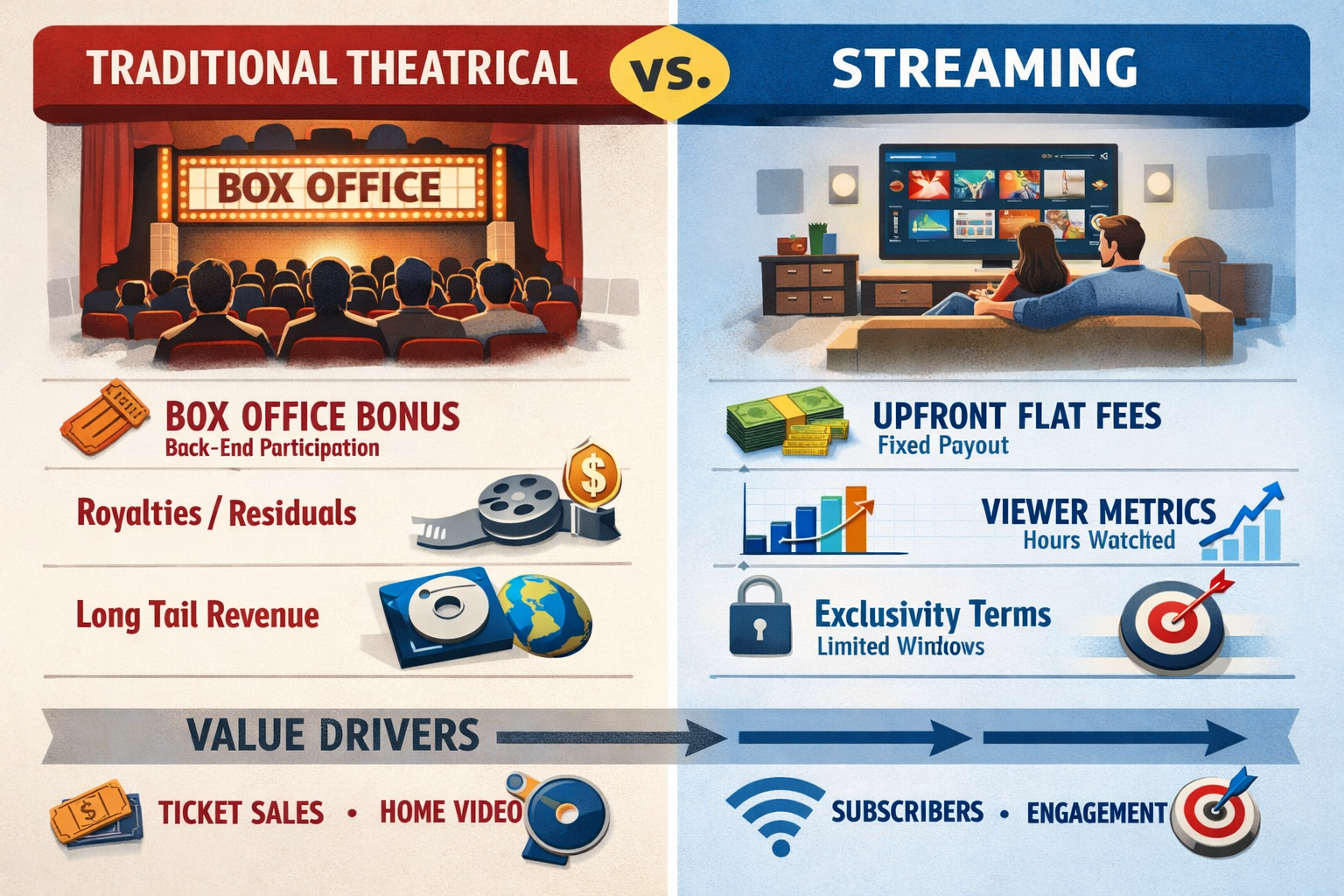
Traditional compensation models built around theatrical box office have increasingly shifted toward engagement-and viewership-based incentives. That creates real opportunity for talent — but also a core drafting problem: streaming “success” is often measured inside platform systems, which can make bonuses and backend participation difficult to define, verify, and enforce.
In response, recent guild bargaining (e.g., the WGA and SAG-AFTRA) has pushed for compensation frameworks that connect performance-based payments to clearer standards and disclosure. At the same time, some platforms have begun releasing engagement-style reporting (for example, Netflix’s “views” methodologies are derived from hours watched divided by runtime). Even partial transparency matters: it creates shared vocabulary for negotiating definitions, time windows, and verification mechanisms.
Several market forces shape today’s negotiation environment: in many streamer-facing deals, traditional box office bonuses are replaced or supplemented by viewership thresholds, tiered “success” bonuses, and other engagement-linked triggers; global distribution makes international rights more valuable — and more complex — so territorial scope and worldwide buyouts become central economic terms; and with shortened theatrical windows (when theatrical releases occur at all), the timeline for traditional revenue narrows, pushing compensation toward larger upfront guarantees and streaming-specific contingent/backend structures.
Core Negotiation Framework
Most entertainment deals go sideways for one reason: people start redlining before they’ve aligned on the business terms. A cleaner approach is to negotiate in three phases:
- Opening positions (set the frame) — define what matters, key numbers, and the “why” behind your ask.
- Issue-by-issue bargaining — trade value across clauses, not just dollars (payment timing, bonuses, approvals, exclusivity, rights).
- Package deal development (close in bundles) — tie concessions together and force decisions with a package, not endless edits.
Then lock it down with a short term sheet/deal memo, make sure the long-form contract matches it, and keep a written open-issues list so nothing “mysteriously” changes at the finish line. It’s simple — but it prevents the most common mistake in entertainment negotiations: fighting clause-by-clause with no shared sense of what actually costs money, creates risk, or controls the project.
1. Opening Positions
The opening sets the tone and the boundaries. This is where you anchor the deal: what matters most, what you need, and what you’re not giving away. A good opening position leaves room to move — but it moves the conversation in your direction.
For producers, that usually means presenting a compensation structure that protects the budget (and the schedule) while still signaling real commitment to the talent relationship. For talent and reps, it means staking an aspirational number and backing it up with a clean value story: why this client is worth it, and what the project gains by attaching them.
2. Issue-by-Issue Negotiation
Entertainment agreements are interconnected, but you don’t negotiate them by arguing the whole contract at once. You break the deal into the major buckets — compensation, backend, approvals, scheduling, image/likeness, marketing — and you work them deliberately.
This is also how you avoid stalemates. If one issue gets stuck, you don’t burn the room trying to “win” that clause. You park it, make progress elsewhere, and come back with leverage — because you’ve already built movement and narrowed the remaining gaps.
3. Package Deal Development
The real close happens when you stop negotiating single clauses and start negotiating packages. This is where trade-offs become explicit and the deal actually becomes signable.
A producer might move on base fee if backend exposure is capped or tightly defined. A rep might accept heavier marketing obligations if the consultation rights are real, the notice periods are reasonable, and the schedule protections are clear. The point isn’t to “win” each term — it’s to build a package where each side gives up something they value less to get something they value more.
Understanding Stakeholder Perspectives
Good negotiation starts before the redline. You need a clear read on what each stakeholder needs, what they can’t give, and where they actually have leverage. If you don’t understand the pressures on everyone at the table, you’ll push on the wrong points — and leave value on the table.
Think in “Interests,” Not Just Positions (Map the Room Before you Move)
In streaming talent deals, you’re rarely negotiating between just two parties. It’s usually a four-corner dynamic:
- Production company (indie producer): needs budget certainty and schedule flexibility, wants to control merchandising, and wants to cap backend exposure.
- Talent / Talent Rep: wants strong base compensation, real upside tied to performance, a share of image/merch value, and clear scheduling carve-outs and consultation points.
- Platform: wants costs to stay proportional, protects subscriber and performance data, preserves a platform-wide merch strategy, and often pushes for broader marketing obligations.
- Guild/Legal Counsel (as applicable): ensures minimums and residual frameworks are respected, limits unreasonable exclusivity, and builds guardrails around digital likeness/AI and enforceable approvals.
Notice what’s happening: everyone has a money ask, but the real friction is usually data, control, time, and rights. If you negotiate this like it’s “money only,” you miss the real trade space — and you leave value on the table.
The Production Company Perspective
Indie producers live inside fixed numbers. If the film is $18M and $3.5M is the talent bucket, a $4M base ask may simply not fit — no matter how “market” it feels. Producers protect budget integrity, limit backend that can hollow out profitability, keep merchandising control where it helps recoup, and preserve schedule flexibility (because delays burn cash). Their leverage is the project itself: the script, the director, the package, and the role’s upside.
The Talent Rep Perspective
Reps are paid to optimize both today’s fee and tomorrow’s career. Sometimes a slightly below-market base makes sense if the project moves the client up a tier. They push for competitive base comp, real upside tied to verifiable triggers, strong likeness/merch protections, schedule carve-outs, and meaningful consultation (not vague promises). Their leverage is the talent’s heat: audience pull, awards credibility, genre track record, and credible competing offers.
The Platform Perspective
Streamers negotiate through subscriber math: acquisition, retention, and brand consistency. They want talent costs proportional to their business reality, they guard performance data, they often centralize merchandising strategy, and they expect real marketing availability. Their leverage is scale — global distribution, marketing muscle, and the ability to make a project feel “worldwide” overnight.
Guild Considerations
Post-2023, streaming compensation and AI/digital likeness concepts have a clearer baseline — but there’s still plenty to negotiate above minimums. The non-negotiables are compliance with minimums, workable exclusivity, appropriate residual structures, and guardrails that protect performers and productions. If the deal falls below guild minimums, it’s not a deal — it’s a problem.
Navigating complications
Deals don’t move in a straight line. Trade heat can change leverage overnight. Subscriber growth can widen a platform’s appetite. Insurance spikes can compress the budget mid-stream. New guild guidance (especially on AI/digital likeness) can reopen “settled” terms. Here’s the move: treat it as change of scope, price it – rather than giving concessions for free – and keep going.
Issue-by-Issue Negotiation: Clauses that Move the Deal
This is where deals get made — or die. Most contracts don’t blow up over one “big” term — they blow up because the parties never controlled the handful of clauses where tiny wording changes swing real money, control, and risk.
Now let’s get specific:
1) Compensation Structure (Base + Real Upside)
Don’t fight only over the base fee. Build a compensation ladder: a base amount tied to clear payment milestones, plus bonuses and upside that are actually collectible (production start, delivery, awards campaign, performance tiers), and don’t forget reimbursements/perks — those are often easier to approve than headline fee. The move is simple: turn a hard “no” on base into a “yes” on upside — but only if the trigger is measurable and enforceable.
2) Performance/Viewership Bonuses that can be Enforced
If “backend” depends on performance, you have to define the math. What is a “view”? What’s the measurement window? Which territories count? What are the tiers? And how is it verified — reporting cadence, certification, and a limited audit concept (often through a third party under NDA). You’re also protecting against moving goalposts: no unilateral methodology changes that quietly kill the bonus. Even when a platform won’t fully open its books, you can still negotiate definitions, a certification mechanism, and remedies if reporting doesn’t happen. If reporting is late/withheld, what happens — deemed achieved, cure period, payment acceleration, injunctive relief, etc.
3) Merchandising and Image/Likeness Rights (The Quiet Value)
This is where value hides.
Platforms often want consistent, centralized merchandising; talent wants participation and guardrails. The middle ground is usually: define categories (posters vs. apparel vs. video games), narrow approvals to name/likeness only (approval not to be unreasonably withheld), set the revenue split based on leverage, and reserve carve-outs for festivals, awards campaigns, and charitable uses.
4) Scheduling, Exclusivity, and “Availability”
Deals get unreasonable here without anyone noticing. Marketing obligations have expanded, and vague “availability” language can swallow a calendar. Treat hold dates and firm dates as different things — and define who pays if either one is broken. Keep it sane by capping promo days, requiring reasonable notice, distinguishing remote from in-person, building around known commitments, and limiting exclusivity to tight windows and specific categories.
5) Creative Input vs. Creative Control
Most creative fights come from vague phrases like “meaningful consultation.” Replace ambiguity with specifics: what consultation points exist (character, wardrobe, key scenes, marketing use of likeness), who has final decision-making authority, and a short list of true approvals (credit placement, name usage, likeness restrictions). For directors/producers: final cut can be a separate discussion depending on leverage. Clear language prevents “approval rights” from becoming a production-delay weapon.
6) AI and Digital Likeness: Treat It as a Separate Schedule
AI/digital replica rights should not be buried in boilerplate. Define the terms (digital replica, synthetic performance, training, derivative use), require informed consent and separate compensation for synthetic use, limit reuse across sequels/spinoffs/marketing unless expressly granted, and add a compliance process (notice, approvals, takedown/remedy mechanics). No training rights by default. If they want training, it’s a separate grant with separate compensation.
Package Deal Development: How to Trade Value and Close Faster
Once you’ve negotiated the major buckets, don’t “win” individual clauses — bundle them.
Example package logic (illustrative):
- Producer/platform moves base fee up modestly if talent accepts narrower creative approvals.
- Talent gets viewership tiers if the reporting mechanism is certification-based and under NDA.
- Marketing days increase if remote appearances count and travel is capped.
- Merchandising share increases if approvals are limited to “name/likeness,” not design veto.
This is where real negotiation happens: you trade what the other side values more than you do.
Handling Mid-Negotiation Curveballs (Without Losing Leverage)
In real negotiations, new information rarely shows up by accident — it shows up mid-stream, and it often shows up strategically. The goal is simple: protect your leverage and keep the deal moving.
Common Curveballs—and the Right Response Pattern
- Budget pressure spikes (insurance, locations, overtime risk).
Response: don’t give away core economics for free. Rebalance the compensation structure — shift value from base fee to clearly defined, enforceable contingent value — but keep payment timing protections (milestones, deposits, late fees, suspension rights).
- Talent leverage jumps overnight (trade heat, competing offer, attachment changes).
Response: don’t panic and don’t “bid against yourself.” Ask: What specific term has to change to get this done? Then trade it for value elsewhere (approvals, schedule, marketing days, backend definition, exclusivity, credit).
- Leadership demands a same-day close (“We need this signed today.”)
Response: agree to a short-form term sheet/deal memo today, with definitive long-form documents to follow — and attach a written open-issues list so nothing gets quietly re-traded in the long form.
- AI disclosure suddenly appears (“created entirely or primarily using generative AI tools”).
Response: treat it as a new risk category. Pause and add an AI/digital rights schedule plus tailored representations and warranties for credit, chain-of-title, and name/likeness protections (including consent and limits on reuse).
Core skill: treat surprises as scope changes that require new terms — not as reasons to concede on the terms you already negotiated.
Documentation and Finalization: Where Good Deals Go to Die (or Survive)
“Agreement in principle” isn’t a deal. The deal is whatever ends up in writing.
Lock the business terms in a short term sheet/deal memo that’s specific enough to control the long form — compensation and bonus triggers, backend definitions and payment timing, approvals (consult vs. consent), schedule windows, marketing obligations, and image/likeness scope. Then keep a written open-issues list. If it’s unresolved, say so — don’t bury it in vague language that turns into a dispute later.
A Negotiation Strategy You Can Use Immediately
Before you mark up a talent agreement (or send your first redline), run this 10-minute checklist:
- What’s the real constraint: cash, schedule, control, or data?
- What’s each side’s must-have nice-to-have?
- What’s your anchor — and what’s your concession plan?
- Which clauses create production risk (approvals, schedule, indemnity)?
- Which clauses create long-tail value (backend, merch, digital rights, AI)?
- Can you define success with measurable triggers?
- Can you close with a package instead of clause-by-clause warfare?
- Do you have a term sheet ready so the deal doesn’t drift?
- Do you have a written open issues list so “agreement” is real?
- Are you documenting assumptions about streaming metrics and definitions up front?
Notes on Market Context (and why “Standards” are only a Starting Point)
“Market” ranges for lead talent in streaming films often float in broad bands depending on leverage, financing, and distribution posture (e.g., $2M–$5M base, with tiered viewership bonuses and merch participation varying).
The right takeaway is not “pick a number” — it’s: build a structure that aligns risk and upside with something you can verify and administer.
Practical Takeaways
Streaming changed the math, but it didn’t change the fundamentals.
Do the preparation: know what you need, what you can trade, and what the other side is actually constrained by.
Negotiate in packages: when one issue stalls, expand the trade space instead of digging in.
Keep it professional: today’s “other side” is often tomorrow’s collaborator, and your reputation travels faster than your redlines.
If you’re negotiating a film/TV or talent deal and want leverage — not surprises — reach out early. Schedule a consultation and we’ll identify the pressure points, map the strategy, and protect the terms that matter.